
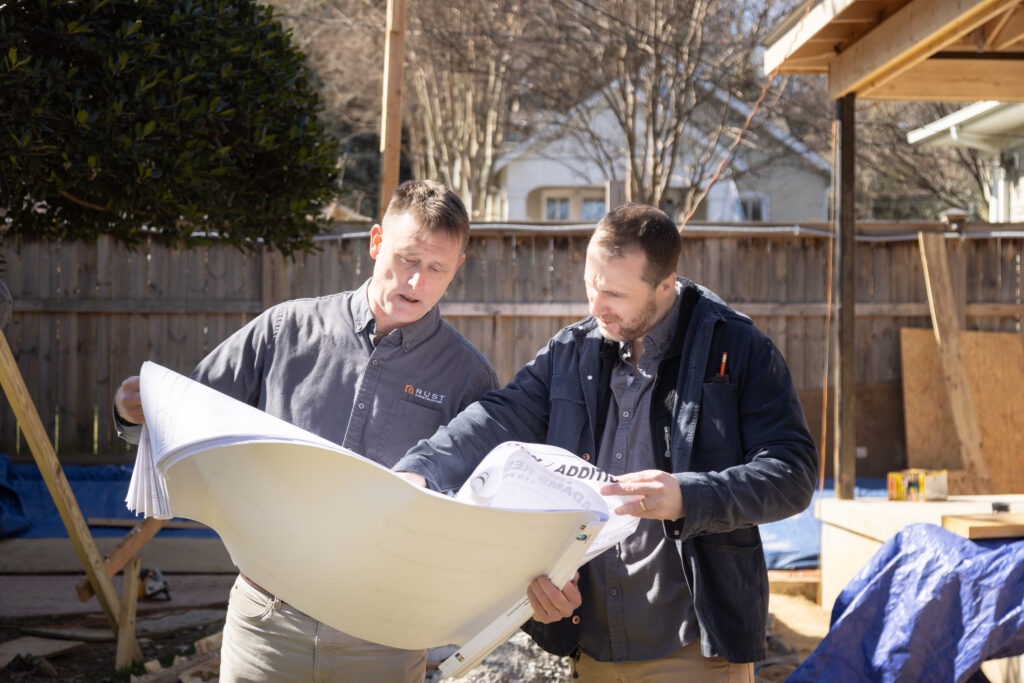
Rust Construction has been a design-build firm since 1956. That year Robert Rust and his brother Gordon Rust, AIA, an architect, took over the family business from their father and relaunched it as a design-build company. Not long ago we renovated a house using Rust Construction blueprints from the 1950s to check existing conditions.
I grew up in Rust Construction’s Old Town studio. It was a couple of blocks from my uncle John Rust’s firm, Rust|Orling Architecture, at 1215 Cameron Street. I spent too many afternoons there asking the architects about their work and keeping them from billable hours. Over the years Rust Construction has worked out of Rust|Orling’s office and Rust|Orling out of ours.
We are design-build not because we discount architectural design but because we value it.
Every remodel and new build must be designed before it can be built. There are two standard ways to do this: bid-build and design-build.
In bid-build, you hire an architect or designer to design the project. Then three contractors typically bid on it. Ideally the architect knows those contractors well and is paid to stay on through construction. Architects call this Contract Administration, or CA, on their proposals. Don’t skimp on paying for this valuable service.
In design-build, design and construction happen under one contract. One team is accountable for both. The working relationship between designers and builders is built in, so is the CA.
What the difference looks like
In bid-build, the design is often finished before anyone prices it. Bids can come in over budget after the homeowner has fallen in love with a completed design they can’t afford. The fix is redesign or cutting scope, and both cost time and fees. Contractors price what is on the drawings, not what the house will reveal once the walls are open. Gaps in the drawings become change orders. When a problem shows up on site, the architect and the contractor each have a reason to point at the other. The homeowner sits in the middle.
In design-build, the people pricing the work are in the room while it is being designed. Budget, structure and design intent get worked out together from the first meeting. The builders know what old houses hide and plan for it. When something needs to change, one team owns the decision. Designs can still come in over budget. The difference is that you find out early, while there is still time to adjust.
How pricing works at Rust
We price a project three times during design.
The first is a ballpark budget before any design work starts. It’s based on comps, similar projects we have built.
The second comes at the end of schematic design. The preliminary drawings are done but most details are not. This is the go/no-go point. Do we refine the drawings to reduce scope or find savings, or do we proceed? We also set allowances for everything not yet chosen: windows, doors, tile, flooring, cabinets, fixtures and exterior materials. Those allowances guide the rest of design.
The third comes once structural engineering is done and we have wall sections, interior elevations and final selections. We reprice the full project from those.
The honest trade-offs
Design-build isn’t the right fit for every project. Bidding a finished design to several contractors can produce a lower construction price. It also gives the homeowner an independent architect whose job is to hold the builder to the design. Bid-build works best when the architect is experienced, the drawings are thorough and the owner wants competitive pricing on a fixed scope.
Design-build gives up competitive bidding. In exchange you get one team that owns the budget, the design and the buildability from day one. There is also something harder to measure. In bid-build, what you liked about your architect doesn’t carry over to the builder. In design-build, the people and communication style you chose at the start stay with you through construction and after.
Where architects fit
Rust Construction also works with architects and designers our clients hire directly. We value those relationships. These projects go best when we join early in design. We can price the drawings as they develop. We can open walls or dig test pits to see existing conditions before the scope is locked. We can also help price and source selections early, including fixtures, windows, doors and other specialty items.
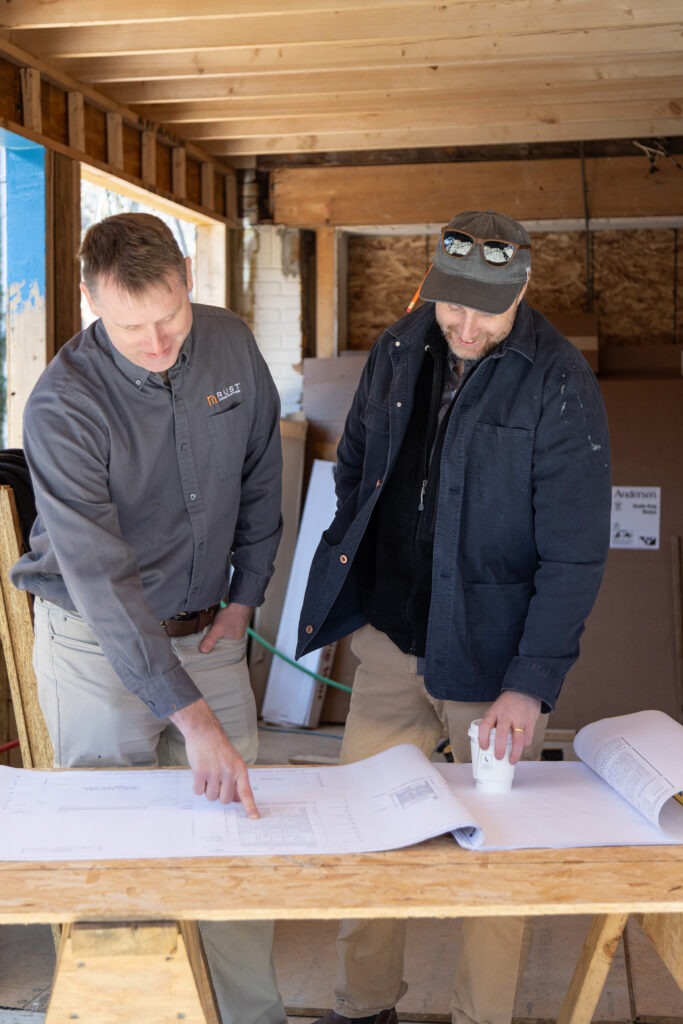
Most of our work is design-build. We have a great in-house design team. We also partner with local firms known for thoughtful design and deep knowledge of Alexandria homes, including Rust|Orling Architecture and Lyon Architecture.
Why local expertise matters
In Old Town and Parker-Gray, additions and most exterior changes need approval from the Board of Architectural Review. The designer and the builder both need to know how that process works. Every jurisdiction has its own version of this. Permitting and building in American University Park in DC is very different from Old Town.
In Alexandria, BAR approval comes early. Most projects go to hearing before structural drawings, finishes and mechanical, electrical and plumbing scopes are developed. A team that has been through BAR review many times knows what the board is likely to approve. It knows which materials and details hold up on a historic facade without breaking the budget. It can price the project realistically before the hearing, not after. That knowledge sits inside one team instead of being split across two firms that may never have worked together. The rules differ in DC, Arlington and Fairfax but the principle is the same. Small things a less experienced team misses can cause costly delays.
The rules also change. Even experienced architects, designers and builders run into problems. That comes with building under different rules in every jurisdiction and neighborhood.
The design fee question
Design-build firms structure design fees differently. Some charge a flat fee upfront. Some fold design into the construction contract. Some charge a percentage of estimated construction cost. None is inherently better. Know which model you’re agreeing to, what happens to the fee if you don’t proceed to construction and when you get a real, buildable estimate instead of a budget range.
At Rust Construction, the design agreement is separate from the construction contract. Design is billed on time and materials, with a budget set by the complexity of the project. Construction is fixed price. No deposit is required to sign a design agreement. We ask for a 5% preliminary deposit at the end of schematic design. It is credited toward the construction deposit of 20% to 30% when the construction contract is signed. On a 25% deposit, for example, you would pay the remaining 20% at signing.
Ask the same payment questions you’d ask any contractor, starting with how deposits are structured. The City of Alexandria’s consumer guidance recommends keeping any deposit to 30% of the contract price or less. Its “Before You Hire a Contractor” guide lists other protections worth knowing.
-Sam Rust
Rust Construction has designed and built projects in Alexandria for generations, read more about our history, with design and construction under one roof. If you’re weighing design-build against hiring separately for a project in Old Town or anywhere in the city, we’re glad to walk you through how we work. Contact us, or take a look at some of our featured projects first.