How to Choose the Right Countertop Material for Your Kitchen or Bath Remodel
posted in: Design and Process
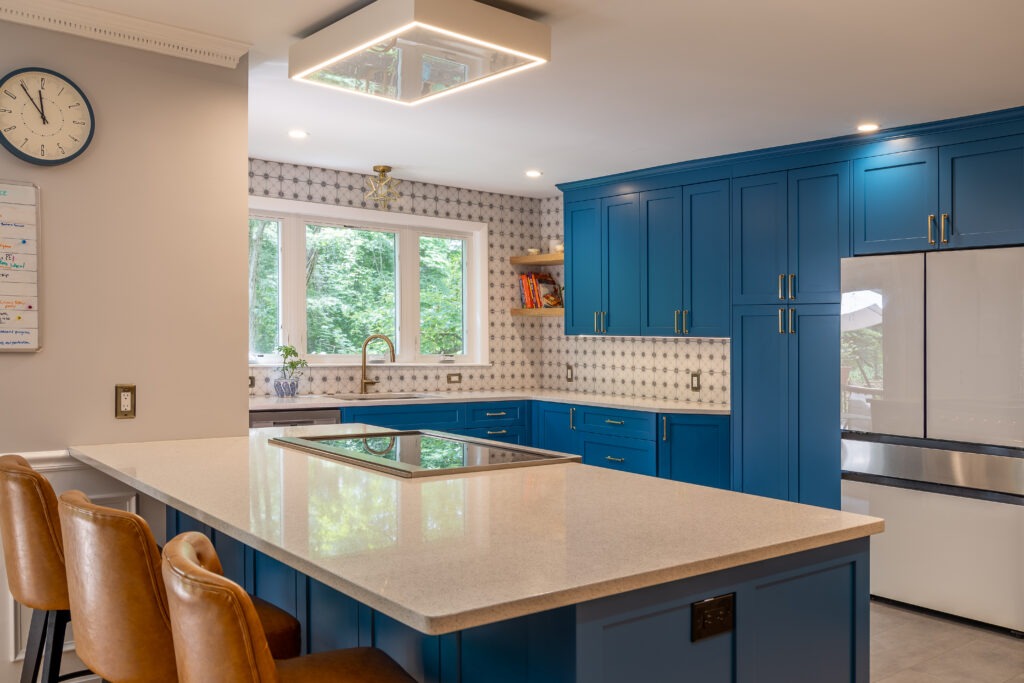
This Rust Construction kitchen features white quartz countertops paired with bold blue cabinetry, creating a clean, durable surface for everyday cooking and gathering.
At Rust Construction, we work with homeowners in Alexandria and Arlington to design, and build kitchens and bathrooms. Countertop material selection matters more than most people expect. Counters are not just for looks, but for how your kitchen functions every day.
A material that looks great in a showroom can frustrate you for years if it does not fit the way you actually live.
Why Countertop Material Matters
For most homeowners, the shortlist comes down to quartz, granite, and marble. Less common on our projects are soapstone, wood, metal, porcelain, concrete, limestone, tile, and Formica. Each has different tradeoffs across durability, upkeep, style, and cost. Here is what you need to know before you decide.
Here is what you need to know before you decide.
At a Glance: How Eleven Material Options Compare
Material
Relative Cost
Durability
Maintenance
Heat Resistance
Best For
Quartz
$$–$$$
High
Low
Moderate
High-traffic family kitchens; modern or transitional spaces
Granite
$$–$$$
Very High
Low–Mod.
High
Active cooks seeking natural variation and long-term durability
Marble
$$$–$$$$
Moderate
High
Moderate
Lower-traffic kitchens where aesthetics take priority over practicality
Soapstone
$$$
High
Low–Mod.
High
Spaces needing a softer, natural look across traditional, farmhouse, or contemporary styles
Wood
$$
Moderate
High
Low
Designs that benefit from warmth and organic character, especially as an accent surface
Metal (Stainless Copper, Zinc)
$$-$$$
Very High
Low-Mid
Very High
Professional, seamless kitchens where patina, scratches, and fingerprints are acceptable
Porcelain Slab
$$$–$$$$
Very High
Low
High
Stone-look designs needing low upkeep and thinner-profile applications
Concrete
$$$–$$$$
High
High
High
Custom or industrial kitchens where patina and variation are part of the appeal
Limestone
$$-$$$
Low-Mid
High
Moderate
Spaces where soft patina is appreciated and etching is acceptable
Tile (Depends on the tile)
$ – $$$
High
Moderate
Very High
Period-appropriate or budget-conscious kitchens where grout maintenance is acceptable
Formica
$
Moderate
Low
Low
Budget-conscious remodels, rental properties, and secondary spaces
1. Quartz Countertop Material: Low Maintenance, High Consistency
White quartz countertops bring a clean, durable finish to this Rust Construction kitchen, designed for everyday use and easy maintenance.
Most of our kitchen and bath projects are specified with quartz countertops. Quartz is engineered (man made) but feels like natural stone to the touch. It is manufactured from ground stone bound with resin and is non-porous, highly resistant to staining. It does not require sealing like marble does. That translates to fewer daily worries and less long-term upkeep compared to most natural stones.
Black quartz countertops with bold white veining create a dramatic in this custom bar area by Rust Construction.
Quartz can be made to mimic marble and other natural stone materials and comes in a wide range of colors and patterns. Whether you want a clean white surface, a bold veined look, or something in between, there is likely a quartz option that fits your requirements.
Why homeowners choose quartz:
Non-porous surface resists stains without sealing
Consistent color and pattern from slab to slab
Wide style range to match almost any design and mimic natural stones
Well-suited for busy households with kids or heavy cooking
What to keep in mind:
Quartz is not indestructible. The resin binders that make it non-porous also make it vulnerable to high heat. Placing a hot pan directly on the surface can cause discoloration or cracking. Quality also varies significantly between manufacturers, so brand and fabricator selection matter. Generally, higher natural stone content means higher durability. Brands like Cambria and Silestone have high ratios of natural quartz to resin and are considered more durable than lines that have lower quartz to resin ratios.
Best for: Homeowners who want a refined, easy-care countertop with predictable results.
2. Granite Countertops: Natural Beauty, Built to Last
Granite countertops bring natural movement and long-term durability to this kitchen, paired with soft blue cabinetry and a functional island layout.
Granite has been a go-to material for decades. It is less common on our projects today, but it remains an excellent choice for durability and natural character.
Every granite slab is unique. The natural variation in color, movement, and texture gives each kitchen a one-of-a-kind look that is difficult to manufacture.
Granite is one of the most durable options available. It handles heat exceptionally well, resists scratches in everyday use, and holds up to the demands of an active kitchen.
Why homeowners choose granite:
Unique natural appearance with real depth and movement
Excellent heat resistance, hot pans are far less of a concern
Strong scratch and impact resistance
Widely available with a long track record in residential kitchens
What to keep in mind:
Granite is porous (though less so than marble), which means it typically requires periodic sealing to protect against stains. Many fabricators now offer pre-treated slabs with built-in stain protection, and routine sealing is straightforward once you are in the habit.
Best for: Homeowners who want natural stone performance, visual individuality, and a surface that handles serious cooking.
3. Marble Countertop Material: Timeless Elegance, Real Commitment
Marble surfaces bring a timeless, high-end feel to this Rust Construction bathroom.
Few materials carry the design presence of marble. The soft veining, the luminous surface, the instant sense of refinement, marble brings a quality to a kitchen that is genuinely hard to replicate.
It is a particularly strong choice for more traditional, architectural, or high-design kitchens where aesthetics are a top priority.
Why homeowners choose marble:
Iconic, timeless appearance
Natural veining that creates genuine visual drama
Elevates the overall design of any kitchen
A classic choice in high-end remodels
Marble requires honest expectation-setting. It is softer and more porous than granite or quartz, which means it is more susceptible to etching from acidic foods (think lemon juice, vinegar, wine) and staining if spills are not cleaned promptly. It will show wear over time.
For homeowners who love materials that age gracefully and develop character, that is part of the appeal. For homeowners who want a surface that stays pristine with minimal effort, marble is likely to feel frustrating.
Best for: Homeowners who prioritize aesthetics and are comfortable with a surface that shows wear over time.
4. Soapstone Countertops: Understated, Warm, and Genuinely Durable
Black soapstone countertops add a rich, classic feel to this kitchen, paired with traditional cabinetry and a simple white tile backsplash.
Soapstone does not get the marketing attention of quartz or granite, but it deserves serious consideration, especially in the right home.
Soapstone countertops add a clean, durable surface to this rustic bar area, contrasting with exposed brick and a vaulted ceiling for a refined yet historic feel.
It has a soft, matte appearance that feels warm and lived-in rather than polished and sharp. It develops a natural patina over time, deepening in color and character with age. In kitchens designed to feel historic, authentic, or quietly refined, soapstone often outperforms flashier options.
Why homeowners choose soapstone:
Rich, natural character with a distinctive matte finish
Develops a beautiful patina as it ages
Excellent heat resistance, among the best of any countertop material
A natural fit for older homes, historic renovations, and classic kitchen styles
Non-porous, so it does not require sealing
What to keep in mind:
Soapstone is softer than granite and will show scratches and dings more readily. That said, minor scratches can often be sanded out and the surface treated with mineral oil to restore its look. If you want a surface that stays perfectly uniform, soapstone is probably not your match. If you like materials that tell a story, it may be exactly right.
Best for: homeowners who want a heat resistant stone with a natural, textured surface that gains character with age.
5. Wood (Butcher Block) Countertop Material: Warmth, Character and Real Maintenance
Wood countertops add warmth and natural character to this open kitchen and dining space. Photo: Clay Banks / Unsplash
Wood countertops are one of the few countertop materials that feel warm to the touch and to the eye. In the right kitchen, a well-executed wood counter reads as intentional and crafted in a way that stone cannot replicate. It is also one of the few materials that a handy homeowner can refinish themselves.
Wood works best as an accent surface i.e. an island top, a baking area, or a secondary run of counter, rather than the primary surface throughout an entire kitchen.
Why homeowners choose wood:
Warm, organic appearance that no stone or engineered material can replicate
Forgiving on dishes and glassware: less likely to cause breakage on impact than hard stone
Can be sanded and refinished if the surface is damaged or worn
Works naturally alongside other period materials in older homes
What to keep in mind:
Wood requires consistent maintenance. It needs to be oiled regularly to prevent drying and cracking, and it is vulnerable to standing water at seams and edges. A wood counter that is not maintained will show it quickly. It is also not heat-resistant. Hot pans will scorch the surface. Cutting directly on wood will leave marks over time, though many clients consider that part of the character. Avoid wood as a primary surface in kitchens with heavy moisture exposure or inattentive maintenance habits.
Best for: Clients who want warmth and handcrafted character, understand the maintenance commitment, and are open to using wood as an accent surface alongside a more durable primary material.
6. Metal Countertop Material: Professional Performance, Distinctive Aesthetic
Zinc countertops develop a natural patina over time, offering a softer, matte alternative to stainless steel with a more lived-in character.
Stainless steel is the standard surface in commercial kitchens for a reason. Stainless is hygienic, nearly indestructible, and indifferent to heat. In a residential kitchen it brings a professional, utilitarian quality that works in modern and industrial designs.
Zinc and copper are less common but worth knowing. Both develop a strong patina over time with zinc toward matte gray and copper toward deep amber and brown. Both materials are occasionally used in farmhouse and historic renovations where aged character is the point.
Why homeowners choose metal:
Exceptional heat and scratch resistance (stainless)
Seamless, hygienic surface with no grout lines or pores to harbor bacteria
A natural fit for homeowners who cook seriously and want a kitchen that performs like a professional one
Zinc and copper offer a patina-forward aesthetic unavailable in any other countertop material
What to keep in mind:
Stainless shows scratches and fingerprints. Over time it develops a brushed-in patina that many clients grow to like, but homeowners who want a surface that stays pristine will find it frustrating. Gauge matters — thinner stainless will flex and dent; 16-gauge or heavier is the standard for countertop applications. Zinc and copper are soft, reactive surfaces that etch with acidic foods and require periodic sealing or waxing. They are specialty choices that reward clients who understand what they are getting.
Best for: Stainless — clients who want a professional kitchen aesthetic, maximum hygiene, and a surface built for heavy use. Zinc or copper — clients renovating older or farmhouse-style homes who want a patina-forward surface with genuine material character and are comfortable with ongoing maintenance.
7. Porcelain Slab Countertop Material: Stone Look, Engineered Toughness
Porcelain slab countertops paired with a stainless steel island create a clean, durable workspace with a modern, professional feel.
Porcelain slab is one of the fastest-growing countertop options on the market. Unlike porcelain tile, it is a large-format, through-body fired material that is harder, denser, and far more stain-resistant.
Porcelain counters are typically installed in thinner profiles than other countertop materials. Porcelain thickness ranges from 6 mm (1/4”) to 20 mm (3/4”) whereas the standard countertop thickness is about 3 cm (1 3/16”). Most porcelain is installed at 12 mm thickness (1/2”).
Why homeowners choose porcelain slab:
Extremely hard and scratch-resistant surface
Non-porous and does not require sealing
Excellent heat resistance
Available in large-format slabs that convincingly replicate marble, granite, and other natural stones
Thinner profiles available, which can simplify detailing
What to keep in mind:
Porcelain slab requires an experienced fabricator. The material is hard, which is part of what makes it durable, but that same hardness makes it more demanding to cut and finish than softer stones. Edge profiles are more limited than with granite or quartz. And because the market is newer, there is more variation in quality between suppliers than you would find with established stone options. Porcelain is brittle and can chip if a heavy pot is dropped. The seams between slabs can be more visible than with other counter materials.
Best for: Homeowners wanting a sleek, low-maintenance, high-performance surface.
8. Concrete Countertop Material: Custom, Industrial, and Built for Character
A concrete countertop creates a clean, monolithic surface with an industrial, custom look.
Concrete countertops are not a mainstream choice, and they are not meant to be. They appeal to a specific type of homeowner: someone who wants a surface that is genuinely one of a kind, is comfortable with a material that develops character over time, and understands that performance requires ongoing attention.
Concrete can be cast in almost any shape, tinted to custom colors, and finished with embedded objects or textures that no other material can replicate. In the right kitchen, it is remarkable. In the wrong one, it can feel like a maintenance burden the homeowner did not fully anticipate.
Why homeowners choose concrete:
Fully custom: shape, color, texture, and embedded details are all possible
Excellent heat resistance
Develops a patina that gives the surface a lived-in, evolving quality over time
Strong fit for industrial, modern, or highly personalized kitchen designs
What to keep in mind:
Concrete requires sealing and periodic resealing to protect against staining. It is prone to hairline cracking over time, particularly as a house settles or with temperature fluctuation. Stains can penetrate if spills are not addressed quickly. The maintenance commitment is real, and homeowners who go into it expecting low upkeep tend to be disappointed. Homeowners who understand what they are getting and embrace the material on its own terms tend to love it.
Best for: Homeowners who want a custom, one-of-a-kind surface and are prepared to maintain it. Works best in kitchens where character and individuality are the primary design goals.
9. Limestone Countertop Material: Historic Character, Real Tradeoffs
Limestone countertops add a soft, natural character to this Rust Construction kitchen, complementing traditional cabinetry and warm wood beams.
Limestone is a sedimentary stone with a soft (softer than marble), warm appearance that reads as genuinely historic. In older Alexandria and Arlington homes where “authenticity” matters, it can feel more appropriate than any engineered alternative. The material has been used in architecture and interiors for centuries, and that history shows.
Why homeowners choose limestone:
Soft, matte, warm appearance that complements traditional and historic interiors
Natural material with genuine depth and subtle variation
Pairs naturally with stone or tile floors, wood beams, and other period materials
What to keep in mind:
Limestone is calcium carbonate, the same base material as marble, which means it etches the same way. Acidic substances like lemon juice, vinegar, wine will dull the surface over time. It is also porous and requires sealing. More so than marble, limestone is a material that develops a patina with use, and that change in character is something homeowners need to accept going in. If you want a surface that stays pristine, limestone is the wrong choice. If you find meaning in a material that records the life of a kitchen over decades, it may be exactly right.
Best for: Clients who accept, and even welcome, a surface that changes with use.
10. Tile Countertop Material: Practical and Underutilized
Tile countertops offer a practical, customizable surface, shown here in a compact bathroom vanity by Rust Construction.
Tile countertops fell out of fashion in the 1990s and have not fully recovered, but they deserve a second look in the right context. In older homes where tile was historically used on counters, a well-executed installation can be more appropriate and interesting than any slab material. Tile is also one of the few countertop materials where pattern and layout are design variables. The same material can read rustic, modern, or period-appropriate depending on format and installation. Tile is a solid option for both budget conscious and less budget constrained projects.
Why homeowners choose tile:
Excellent heat resistance – individual tiles handle hot cookware without issue
Highly durable surface; individual tiles can be replaced if damaged
Wide range of materials, sizes, and patterns available, including options that read as period-appropriate in older homes
Lower cost than slab stone, particularly when using standard tile rather than specialty formats
What to keep in mind:
Grout is the primary maintenance tradeoff. Grout lines stain, require periodic sealing, and can be difficult to keep clean with heavy cooking use. The uneven surface also makes prep work less comfortable than a flat slab. Large-format tiles minimize grout lines and reduce maintenance. Epoxy grout is a worthwhile upgrade in any tile counter installation.
Best for: Homeowners who want something different and are comfortable with grout maintenance as the primary tradeoff.
11. Formica (Laminate) Countertops: Practical, Accessible, and Underrated
Formica countertops provide a durable, budget-friendly surface for high-use commercial spaces like this cafe.
Formica (often called laminate) is easy to dismiss in a conversation dominated by natural stone. But dismissing it entirely misses the point of what it actually does well.
Laminate countertops solve a specific problem: delivering a functional, attractive surface at a significantly lower cost. For projects where budget is the primary driver, or where a lower-use area of the kitchen needs a practical finish, Formica remains a legitimate option.
Why homeowners choose Formica:
The most budget-friendly countertop option available
Easy to clean and maintain day to day
Available in a wide range of colors, patterns, and textures
Resistant to stains in normal use
What to keep in mind:
Laminate has real limitations. It is not heat-resistant, hot pans will cause damage. It is vulnerable to moisture intrusion at seams and edges over time. And it does not carry the long-term durability or resale value of stone. In a premium kitchen remodel, Formica is rarely the right call. But in the right project and the right context, it earns its place.
Best for: Budget-conscious projects, secondary kitchen areas, or renovations where practical function outweighs long-term material investment.
How to Choose the Right Countertop for Your Kitchen or Bath
Rather than asking which material is “best,” ask which one fits your kitchen, your habits, and your priorities.
How much maintenance are you realistically willing to do? If you want the least day-to-day upkeep, quartz and porcelain slab are often the strongest options. Soapstone is also relatively easy to live with, though it will show character over time. If you are comfortable with occasional sealing or more attentive care, granite, marble, limestone, concrete, wood, tile, zinc, and copper can all work well depending on the look you want. Formica is easy to clean, but it comes with other tradeoffs in durability and heat resistance.
How much do you cook, and how much heat will the surface need to handle? If you cook frequently and regularly move hot cookware around the kitchen, granite, soapstone, metal, porcelain slab, concrete, and tile offer the strongest heat resistance. Quartz requires more caution, since excessive heat can damage the resin binders. Wood and Formica are the least forgiving when it comes to direct heat.
Do you want consistency, or do you want natural variation? Quartz and porcelain slab offer the most predictability in color, pattern, and overall appearance. Granite, marble, soapstone, limestone, wood, concrete, zinc, and copper bring more individuality and natural variation. If you want a surface that feels unique and develops more character over time, the natural and patina-forward materials tend to stand apart.
Do you want the surface to stay crisp, or are you comfortable with patina and wear? Some materials are chosen because they stay relatively consistent with everyday use, like quartz, porcelain slab, and stainless steel. Others are appealing precisely because they change over time. Soapstone, wood, concrete, limestone, marble, zinc, and copper can all develop patina, etching, scratches, or subtle wear that become part of the surface’s character. Tile can also age well, though grout maintenance becomes part of the equation.
What is the character of your home? In a historic Alexandria townhome or a classic Arlington Colonial, materials like soapstone, marble, limestone, wood, tile, or even zinc may feel more natural and period-appropriate than a more uniform engineered surface. In a modern renovation with cleaner lines, quartz, porcelain slab, stainless steel, or concrete may be a better fit. Granite can work in either direction depending on the slab and the surrounding design.
Is this your main work surface, or would the material work better as an accent? Some materials are excellent across the full kitchen, while others often perform best in a more targeted role. Wood, for example, is often strongest as an island top, prep area, or secondary surface rather than the primary countertop throughout the entire kitchen. Metal can be a strong choice in focused work zones. Tile can also make more sense in specific design contexts rather than as the default option everywhere.
How important is hygiene and a seamless surface? If a clean, seamless, easy-to-sanitize surface is a top priority, stainless steel, quartz, and porcelain slab tend to stand out. Tile introduces grout lines, and wood requires more care around moisture. Natural stones can perform very well, but their porosity and maintenance needs vary by material.
What is your budget? Costs vary widely depending on the material, the slab or finish selected, fabrication complexity, and installation details. Granite and quartz often compete in the mid-range. Marble, porcelain slab, concrete, and some specialty metals can run higher. Soapstone and limestone vary by source and availability. Wood can be moderate depending on species and use. Tile has a broad range depending on format and labor. Formica is usually the most budget-friendly. Always compare installed costs, not just material pricing.
Why Countertop Selection Works Better as Part of the Full Remodel
Your countertop does not exist on its own. It works alongside your cabinetry, backsplash tile, flooring, lighting, and appliances. A slab that looks perfect in a showroom can feel disconnected once the full kitchen comes together.
That is why countertop selection is most successful when it happens as part of a full design conversation, where materials, proportions, light, and function are considered together from the start.
At Rust Construction, that integrated approach is how we work. We help homeowners in Alexandria and Arlington navigate material choices as part of the complete remodel plan, so the final result feels cohesive, not assembled piece by piece.
Ready to Choose the Right Countertop for Your Kitchen or Bath?
There is no single best countertop material. There is the right material for your home, your routines, your budget and your aesthetic.
Whether you are weighing quartz against granite, wondering if soapstone is right for your older home, or trying to balance quality and budget, we can help you work through it as part of a kitchen or bath design build project.
Contact Rust Construction to start planning your kitchen or bath remodel.