
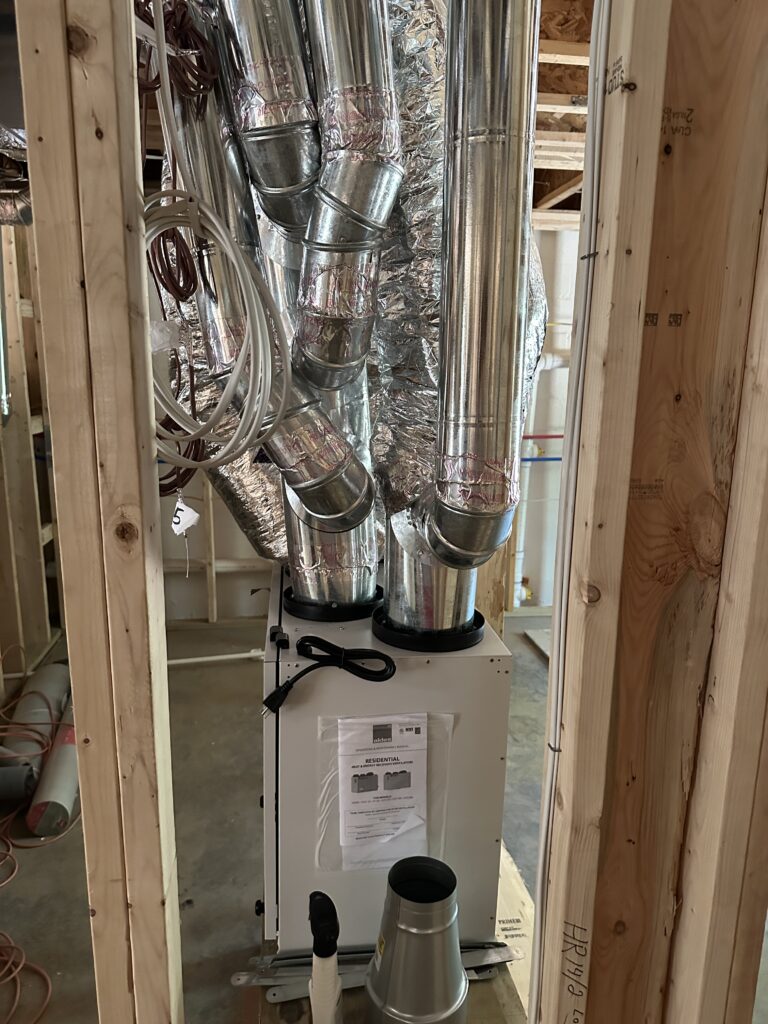
In older homes, fresh air came through gaps in construction – around windows, through walls, and up from basements. Modern building methods create tighter spaces, which is great for energy efficiency, but raises an important question: how do we maintain fresh air without losing the energy we’re working to conserve? This is where Energy Recovery Ventilators (ERVs) come in.
We are just starting to explore this technology. In 2025, we will have done two projects with ERVs: one in VA and one in DC.
What an ERV Actually Does
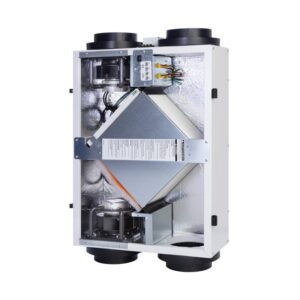
Think of an ERV as your home’s lungs with a built-in heat exchanger. It exhausts stale indoor air while bringing in fresh outdoor air, but with a crucial difference from simply opening a window: the ERV transfers heat and moisture between the two air streams without mixing them.
In winter, when you’re exhausting 70-degree indoor air and bringing in 30-degree outdoor air, the ERV captures up to 85% of the heat from the outgoing stream and transfers it to the incoming fresh air. In summer, it works in reverse, pre-cooling and dehumidifying incoming air using the outgoing conditioned air.
Why ERVs Matter for Your Home
Why we recommend ERVs instead of simpler ventilation methods:
- Energy efficiency translates to real savings. A properly sized ERV typically recovers 80-85% of the energy that would be lost through traditional ventilation.
- Comfort improves markedly. By pre-conditioning incoming air, ERVs eliminate the cold drafts and humidity swings common with other ventilation methods.
- Indoor air quality becomes consistently better. Rather than relying on random air leakage or remembering to open windows, ERVs provide continuous, controlled fresh air.
- Reduces odors and fumes from kitchen particulates (smoke) and can be used in lieu of traditional bath fans.
ERV Installation Considerations
The success of an ERV system lies in proper sizing and installation. We position ERVs centrally in homes, carefully plan ductwork routes, and ensure easy access for filter changes. This attention to detail means the system will function efficiently for decades.
Looking Ahead
As we build increasingly efficient homes, mechanical ventilation isn’t just an add-on – it’s essential infrastructure. An ERV represents a long-term investment in comfort, health, and efficiency. While the initial cost is higher than basic ventilation, the improved comfort and air quality make it worthwhile.
Want to learn more about how ERVs fit into a comprehensive building strategy? Contact us to discuss your project.