
I still remember my first serious brick restoration project as a teenager, working alongside my cousin, John Rust, on a historic home renovation in Alexandria. On the corner of S. St Asaph and Prince Streets in Old Town Alexandria, the home’s front facade was visibly “pregnant,” bowing outward in a way that signaled serious structural problems beneath the surface.
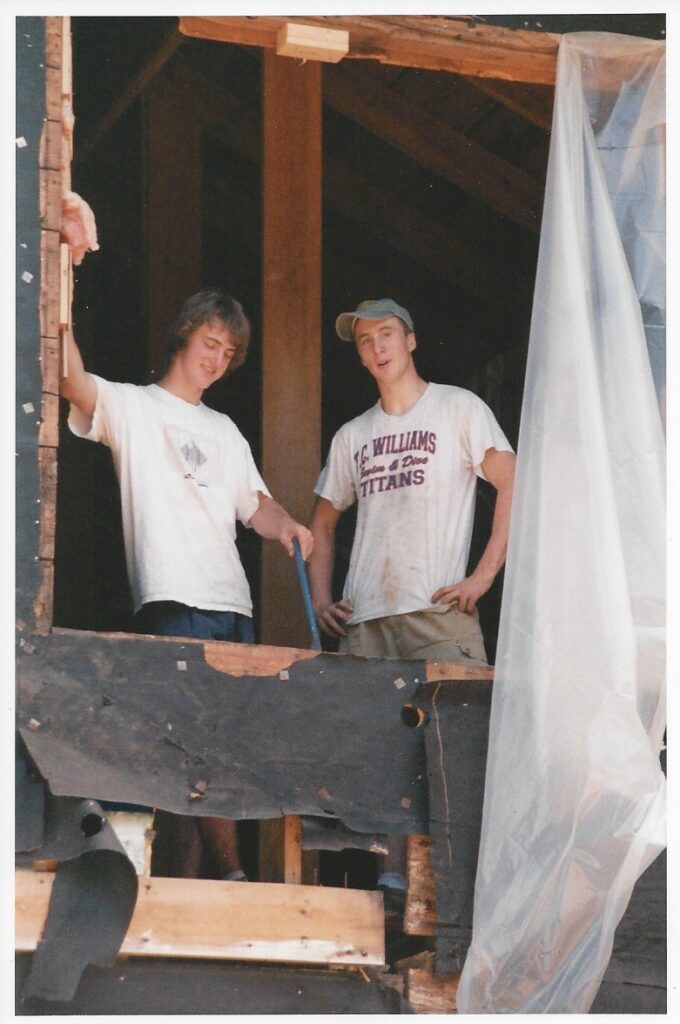
What started as a tuckpointing job quickly became a lesson in making assumptions. We had to tunnel into the crawlspace, crawling through narrow passages with flashlights to assess the damage. What we found was sobering: every brick below grade had literally turned to dust after centuries of moisture exposure.

The original 1800s wall had been built directly on compacted soil, a common and actually quite serviceable historical technique. Our theory was that a neighboring parking lot had altered how rainwater saturated the soil around the foundation, increasing long-term moisture pressure against the historic foundation walls. The wood framing that originally helped hold the exterior walls together had also deteriorated.


The entire foundation needed to be stabilized and rebuilt while supporting the structure above. On a prominent historic property where every original detail mattered, that was no small feat. The wall was rebuilt with specialty salvaged bricks and historically appropriate lime based mortar after we shored up the building and hand dug a concrete footer from within the crawlspace. We felt like miners. In retrospect, it was dangerous, and I would never allow my kids to do the same thing.
The Unique Nature of Historic Home Renovation
That project taught me something I’ve carried into every renovation since: what you can see on the surface is almost always just a hint of the story underneath. In this case, that bowing wall was telling the story of an old foundation, changes in how water interacted with the house, rotting framing, and deteriorating bricks.
This is what makes historic home renovation genuinely different from standard remodeling. The buildings are telling stories in materials, in the softness of hand-pressed 18th-century brick, in oyster shell fragments visible in original lime mortar, in the star-shaped anchor plates bolted to facades throughout Old Town. Reading those stories accurately is the difference between a renovation that lasts and one that creates new problems while solving old ones.
Historic Home Renovation Expertise
At Rust Construction, we’ve spent decades working on historic home renovations in Alexandria, Arlington, and Washington, DC. That experience has taught us to slow down at the beginning, to investigate before we prescribe, and to treat every visible symptom as a question worth asking before we assume we know the answer.
Sam Rust
This is the first in a series on historic masonry. Next: how to read the bricks on your own home and what they reveal about when and how it was built.